
I want to go back to Philmont
(I want to go baaaack to Philmont)
Where the old Rayado flows,
Where the rain come a-seepin'
In the tent where you're a-sleepin'
And the waters say hello.
I want to wake up in the morning
With my socks all wringing wet,
For it brings back fondest memories,
That a Ranger can't forget.
I want to hike once more the canyon floor
From Scribblins to Old Camp,
With my pack sack a-creakin',
With my back with sweat a-reekin',
And my legs begin to cramp.
I want to hike again with such great men
As made those famous treks,
From Beaubien to Porky
And from Cito to Car-Max.
The Ranger · Role & Tradition
The Ranger Department was founded in 1957, when Philmont's Director of Camping Jack Rhea set out to solve a simple problem: crews were arriving from across the country, eager and underprepared, and the backcountry had no patience for either. The solution was a new kind of staff member — part outfitter, part guide, part teacher, part mentor — whose job was to get a crew trail-ready in three and a half days and then trust them to find their own way.
Nominally, a Ranger is an outfitter, a guide, a teacher, and a mentor — a person who takes on a crew of young adventurers, leads them into the Philmont mountains, and points the way until they are ready to function on their own.
Each Ranger begins the season with a fieldbook, a training framework, and a backcountry testing trek. What the framework cannot supply is added through personality and experience. The Ranger conveys not just trail technique but the character of the land: its history strewn in old mines and overgrown railroad beds and tumbledown logging camps, its flora and fauna, the particular quality of the light at 7,000 feet. A good Ranger carries something of the magic of Philmont in the job itself.
By midsummer the Ranger wears the signs of the work: a body-worn map folded in the hip pocket, well-broken boots, the tawny, sun-baked look of someone who has spent months at altitude. The gait is long and conditioned from mountain miles under a pack. In the face of a blowdown, a wildfire, or a lost camper, the Ranger is more likely to be energized than discouraged. Rangers form the frontline of Search and Rescue operations across the ranch — prepared to clear trail, fight fire, or carry a litter off a mountain when called.
The experience produces what observers have called an incurable condition: pride, exhilaration, nostalgia, and longing that can last decades. Former Rangers from different eras, separated by thirty or forty years of Philmont history, find they share something that defies easy description. The song says it for them. The old Rayado flows, and the waters say hello.
The Ranger Bell · Before Every Lunch and Dinner · Since the 1960s
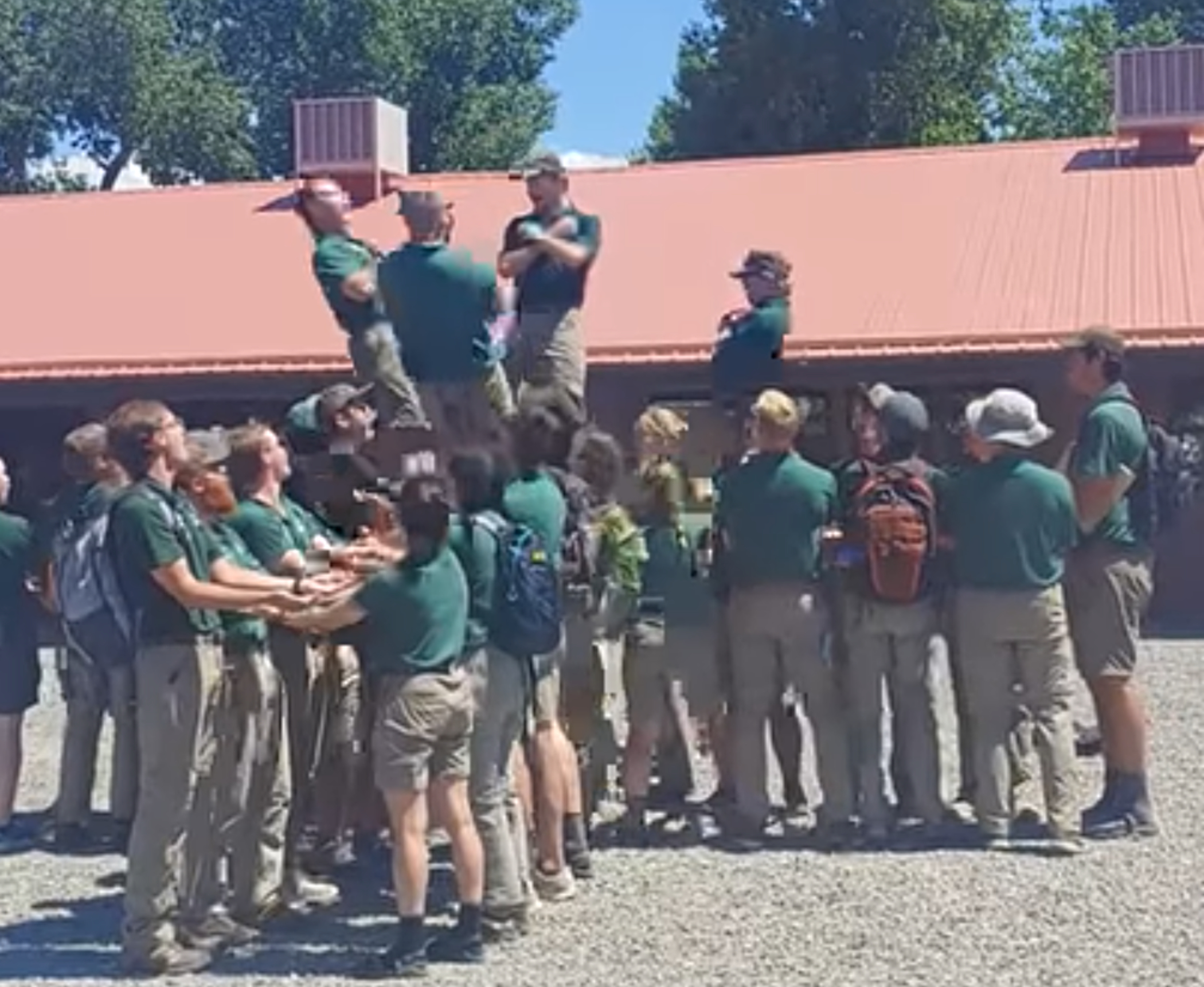
At Camping Headquarters, before every lunch and every dinner, the Rangers gather at the dining hall bell. It is a tradition that has run continuously since the 1960s and is one of the defining rituals of the Ranger Department.
Four Rangers climb to the top of the bell. One of them rings it to call the hall to attention, then tells a story — something personal, something from the trail, something that carries what this place means to them. While they speak, the assembled Rangers below are listening. When the story ends, the four on top of the bell chant the Ranger Song together. And in the middle of the chant — they fall. Backward, off the bell, into the hands of the Rangers waiting below.
The trust fall is literal. The bell rings, the story is told, and someone has to believe that their people are there.
The ceremony runs the whole summer, every lunch, every dinner — hundreds of times across the season. Different Rangers tell different stories. The same song plays underneath all of them. It is one of the less publicized traditions at Philmont and one of the most remembered by those who lived it.
Ranger Cobbler · First Night on the Trail · Cast Iron · Coals
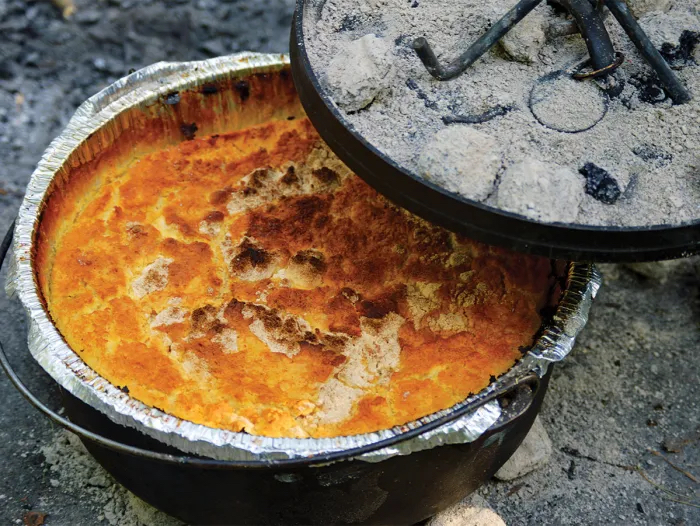
In the Ranger tradition of the 1980s, the crew's first night on the trail ended with something unexpected: their Ranger made peach cobbler in a cast iron Dutch oven over the campfire coals. It was a gift — not required by any job description, just something Rangers did. Biscuit dough dropped over hot peaches in heavy syrup, lid on, coals stacked on top, twenty minutes, golden brown. Out in the backcountry, at 8,000 feet, after the first full day of hiking, it landed differently than cobbler ever does anywhere else.
Part of the performance was the implication that the Ranger had carried the Dutch oven — a heavy cast iron pot — in his pack all day on the trail alongside everything else. He never quite said it directly. He didn't have to. The crew drew the obvious conclusion and were suitably impressed. The secret, known to Rangers and no one else, was that Dutch ovens were cached in bear boxes near the backcountry camps before the summer began. The Ranger retrieved it after the crew made camp. The cobbler tasted the same either way. The story was better the original way.
The recipe has been in the Boy Scout Handbook for generations and circulated widely enough to carry its own name: Philmont Ranger Cobbler. The Dutch oven technique — cast iron preheated over coals, more coals on the lid to create an oven from the fire up and down simultaneously — is as old as the American frontier. Lewis and Clark carried Dutch ovens. Ranchers and homesteaders baked in them across the West. Philmont's Rangers kept the tradition alive in the mountains of New Mexico, one crew at a time, first night on the trail.
Dutch Oven · Backcountry · First Night on Trail
- 2 cans (16 oz each) peaches in heavy syrup
- 2 cups dry biscuit mix
- ½ cup sugar
- ½ teaspoon cinnamon
- Preheat a Dutch oven over a good bed of coals.
- Pour the juice from one can of peaches into the oven. Set aside the juice from the second can.
- Add the peaches from both cans. Sprinkle with sugar and cinnamon. Bring to a boil.
- Combine biscuit mix with reserved peach syrup in place of water to make a soft dough.
- Drop spoonfuls of dough over the hot peach mixture.
- Cover with lid. Set over 10–12 glowing coals. Stack 18–20 more coals on the lid.
- Bake approximately 20 minutes, until biscuit tops are golden brown.
- Wipe out the oven after cooling. Rinse with clear water only — no soap.
There was one more thing. After the crew was asleep and the oven had cooled, the Ranger cleaned it — wiped it out, rinsed it with clear water, dried it, re-seasoned it, and left it ready for whoever came next. Inside the clean Dutch oven, he left a note. Something brief — a name, a date, a line about the crew, something from the night. Rangers kept their own counsel about what they wrote. The next Ranger would find it when he pulled the oven from the cache and would add his own before the season was out. A record kept in cast iron, passed hand to hand through the backcountry, one crew at a time.
Philmont has since moved away from wood fires in the backcountry. The tradition has moved with it — cake over a gas stove, now, in place of cobbler over coals. It is not quite the same as it was in 1981.
The Ranger Axe · Tool, Mark, and Memory
Every Ranger carried an axe. Not a hatchet — a proper trail axe, short-handled, single-bit, with a head ground to a working edge that could hold through a full day of use. The axe was part of the Ranger's kit from the first morning of training and stayed there for the season. In the years before Philmont moved away from wood fires, it was practical equipment: blowdowns across the trail, limbs brought down by overnight storms, kindling split for the fire that would heat the Dutch oven. A Ranger who did not know how to swing an axe properly was a Ranger with unfinished preparation.
The axe was a tool. It was also a credential. In the backcountry, the way a Ranger handled the axe told the crew something about everything else.
The care of the axe was part of the instruction. Edge maintenance — the file, the whetstone, the leather strop — was demonstrated on the first night out, often around the same fire where the cobbler was baking. The lesson was explicit: a sharp axe is safer than a dull one because it bites where you aim it. A dull axe glances. Rangers sharpened their axes the way they set up camp — methodically, completely, before sleeping. The mask went on the edge when the work was done.
By midsummer a Ranger's axe had acquired its own biography. The handle wore down the finish at the grip. A nick in the bit marked the flint in that wash above Beaubien. Some Rangers carved their initials into the handle; others notched it by crew or by season. The axe was not government issue — a Ranger bought his own and it remained his. When the season ended and the Ranger drove away from Cimarron, the axe went with him. Somewhere there are axe handles with decades of mountain weather in the grain.
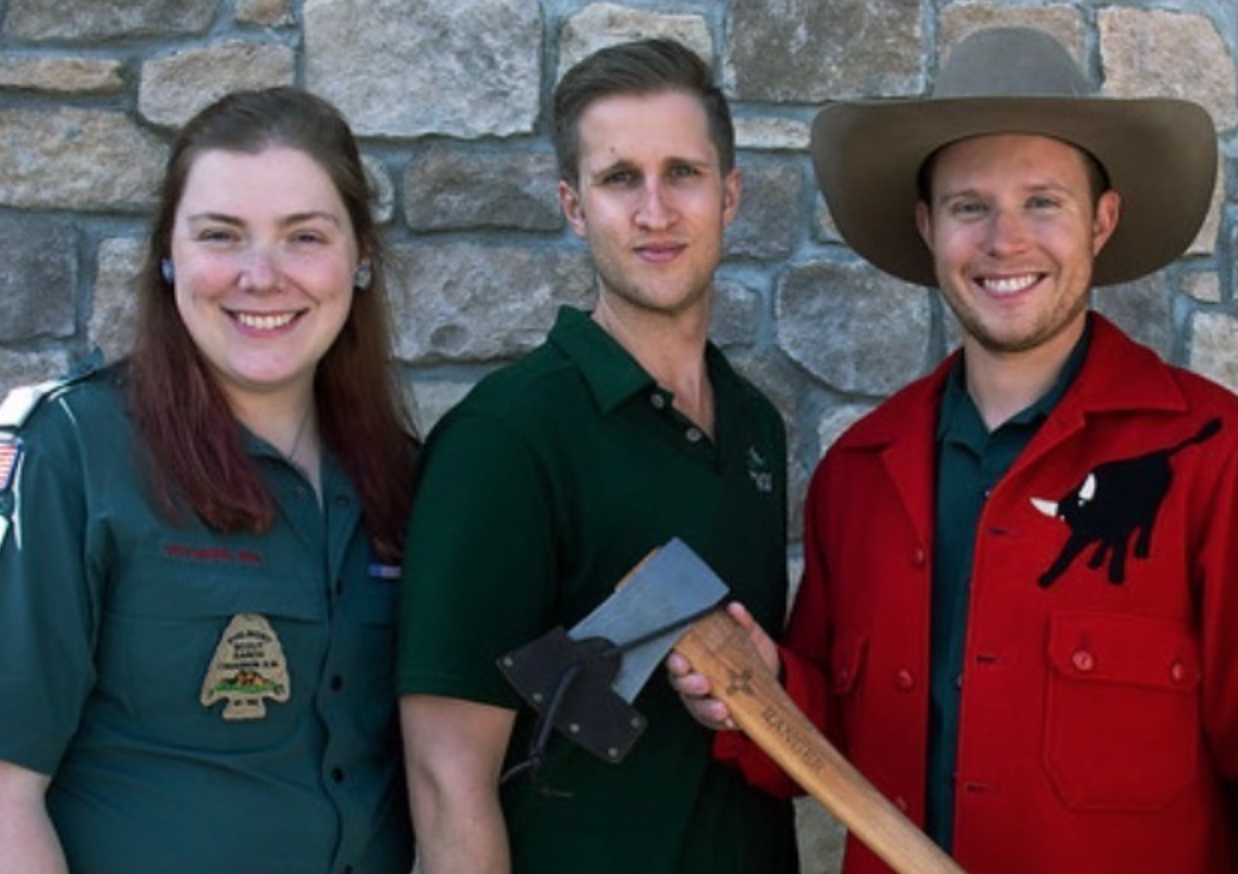
Will earned his Ranger axe in 2022 — his season on the Ranger Department — and it sits at home now, well kept, the kind of object that does not need to be explained to anyone who knows what it is. One season as a Ranger. One axe. The rest of the story is eleven seasons on Philmont staff across Ranger, Conservation, Conservation Foreman, and every shoulder of the year the ranch is open.
He carried the axe for one season as a Ranger. Who knows — maybe that was enough. Maybe that is exactly why he spent the other ten seasons in Conservation.
Conservation staff at Philmont do not carry axes as a matter of daily routine. They carry pulaskis, McLeods, crosscut saws, rock bars, and enough other trail tools to outfit a small crew indefinitely. The work is different — less about introducing a crew to the backcountry and more about keeping the backcountry worth introducing anyone to. But the axe sits at home waiting, and a Ranger is still a Ranger.
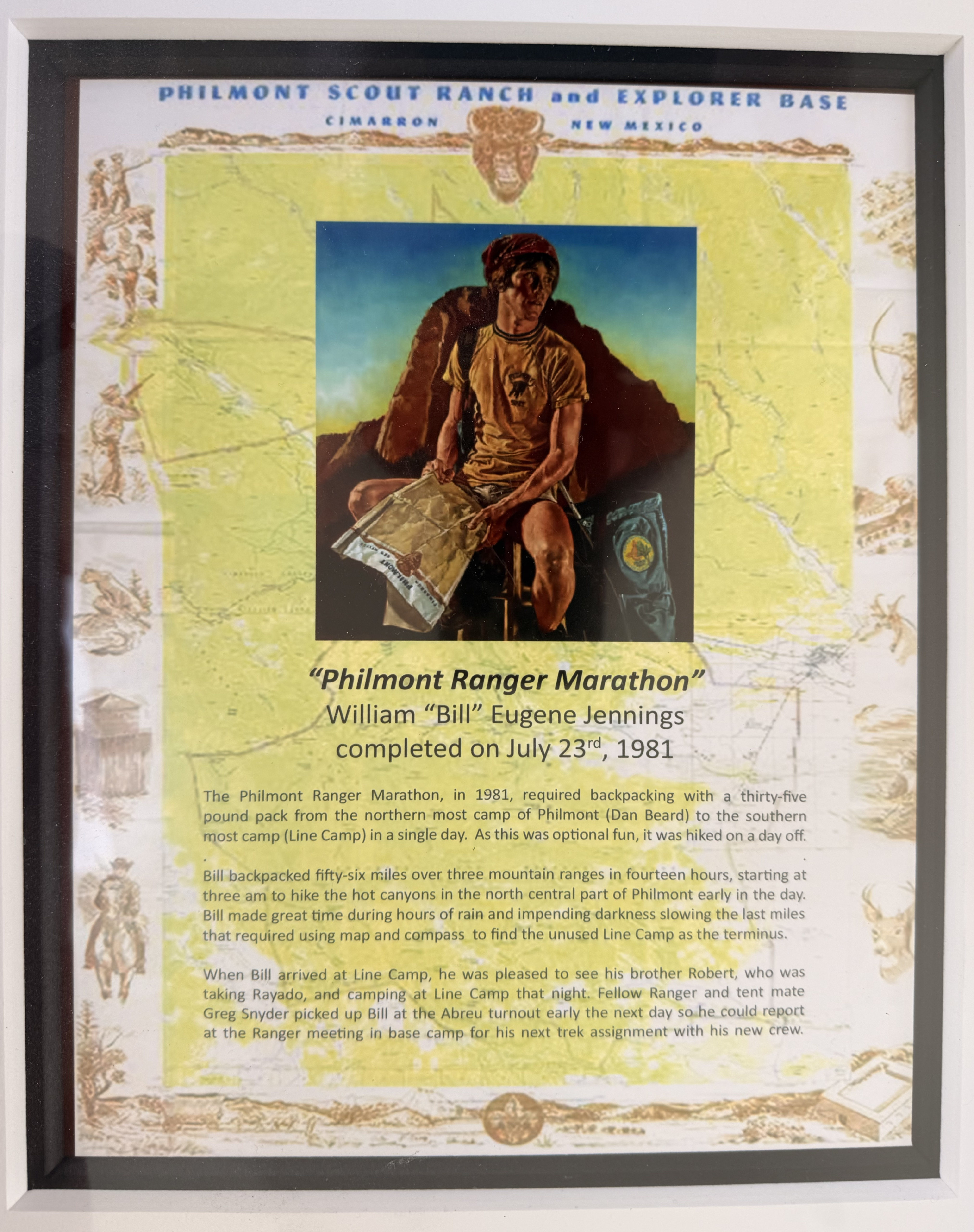
The Philmont Ranger Marathon was an unofficial tradition — optional, unrequired, done on a day off. The challenge: backpack with a thirty-five pound pack from the northernmost camp at Philmont, Dan Beard, to the southernmost camp, Line Camp, in a single day. The full length of the ranch, end to end, on foot, under load, with no crew to shepherd and no schedule but your own.
On July 23, 1981, Bill did it. Fifty-six miles over three mountain ranges in fourteen hours. He started at three in the morning to beat the heat of the canyons in the north-central ranch, covering the most exposed miles while the day was still cool. By midday the monsoons had arrived. By evening the darkness was closing in and the trail had run out — Line Camp was unused that summer, unmarked and difficult to locate, and the final miles required navigating by map and compass through fading light to find a terminus that wasn't expecting anyone.
Fifty-six miles. Three mountain ranges. Fourteen hours. Started at three in the morning to beat the canyon heat. Finished in the dark with a compass and a map.
When Bill walked into Line Camp, he found his brother Robert there — Robert was running Rayado that summer and his crew happened to be camping at Line Camp that night. The reunion was unplanned and exact. Fellow Ranger and tentmate Greg Snyder drove out to the Abreu turnout the next morning to collect Bill before first light, so he could be back at Camping Headquarters in time for the Ranger meeting and his next trek assignment with a new crew.
One day off. Fifty-six miles. Back on duty the following morning.
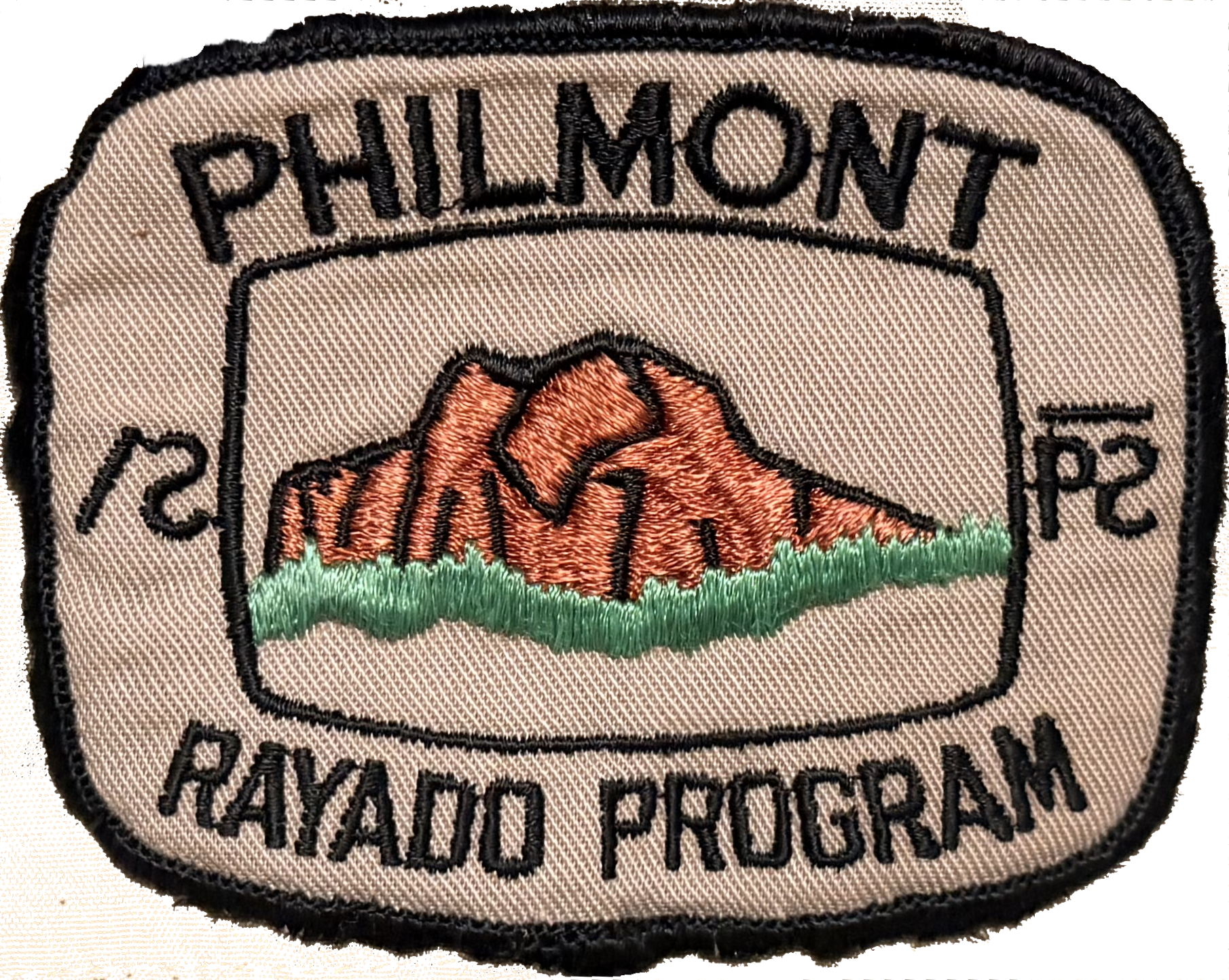
For many who become Rangers, there is something that comes first. Rayado is the longest and most difficult outdoor program the Boy Scouts of America offers — a 21-day backcountry expedition covering roughly 200 miles through the rugged mountains of northern New Mexico. It is designed, explicitly, to change you.
The challenges are unknown, the stakes are high, and the growth is unforgettable.
Unlike a standard Philmont trek, where a troop registers and hikes together, Rayado crews are provisional — assembled by Philmont from individuals who sign up alone. A Scout arrives at Base Camp, meets strangers from across the country, and within days is deep in the backcountry with them. Routes are kept confidential; participants never know exactly what is coming. Crews rotate leadership roles daily — crew leader, navigator, chaplain, wilderness guide — so that responsibility moves through every member of the group.
Two Rangers accompany each Rayado crew throughout the trek. Those Rangers have often completed Rayado themselves. The experience operates on both sides of the rope: the program produces the people who later lead it. Rayado participants can access both the northern and southern reaches of Philmont's 140,000 acres — terrain closed to standard crews — including high summits, the Valle Vidal, and route miles that test even well-conditioned hikers. The elevation swings from 6,500 feet to above 12,000. August monsoons are part of it. So is the sky at night when the clouds clear.
By the last day, people who arrived as strangers are something else. That transformation — forged in mileage and weather and shared hardship — is part of what the Ranger tradition runs on.
From the highway at Cimarron you see it before you see anything else — a jagged spine of volcanic rock rising from the southern end of the ranch, bare and definite against the New Mexico sky. The Tooth of Time. It appears on the Philmont patch, on the belt buckle, on the literature. Every crew that comes to the ranch sees it on the drive in. Not every crew summits it.
The summit sits at 9,003 feet. The approach trail from the south is steep and rocky, loose in stretches, and the last several hundred feet require hands as well as feet. On a clear morning the view from the top is the whole of the country — the Sangre de Cristos running north, the high desert opening east toward the Cimarron River, the ranch spread below like a map of every mile you've covered and every mile you haven't. Most who make it stay longer than they planned to.
Standing on the Tooth is the moment when the ranch stops being a place you are visiting and becomes a place that has marked you.
The red scouting jacket carried its own record. The classic BSA wool jacket — deep scarlet, worn over the uniform shirt in the cold mornings at altitude — was the canvas for felt insignia earned through the program. Philmont's emblem is the bull: the Mexican fighting bull, rendered in the angular style of the ranch brand, tail characteristically swept forward over his back. On a standard Philmont patch the tail falls naturally. On a red jacket worn by someone who has stood at the top of the Tooth of Time, the felt bull is placed with the tail lifted over the shoulder — not just curled, but elevated, a small deliberate difference that anyone who has earned it will see immediately. It is not announced. It does not need to be.
The jackets accumulate these marks the way the axes accumulate their nicks. A patch from each council, a strip from each high-adventure base, the red wool thickening with felt along the chest and sleeves until the jacket itself becomes a document. The Tooth of Time bull — tail over the shoulder — is among the marks that can't be bought or given. You either stood up there in the wind with the whole ranch below you, or you didn't.
There was a variation that belongs to this family. Will's grandmother, Ann Jennings, earned her bull for the red jacket as well — but hers was white felt. For a time, the women's bull was issued in white to distinguish it from the black felt worn by the men. Ann earned hers, wore it, and it sits now as a piece of Philmont history that cannot be replicated: Scouting America has moved away from separate insignia by gender, and the white felt bull is no longer produced. What she earned is the only version that will ever exist. A mark made once, on a jacket that knew the same mountain.
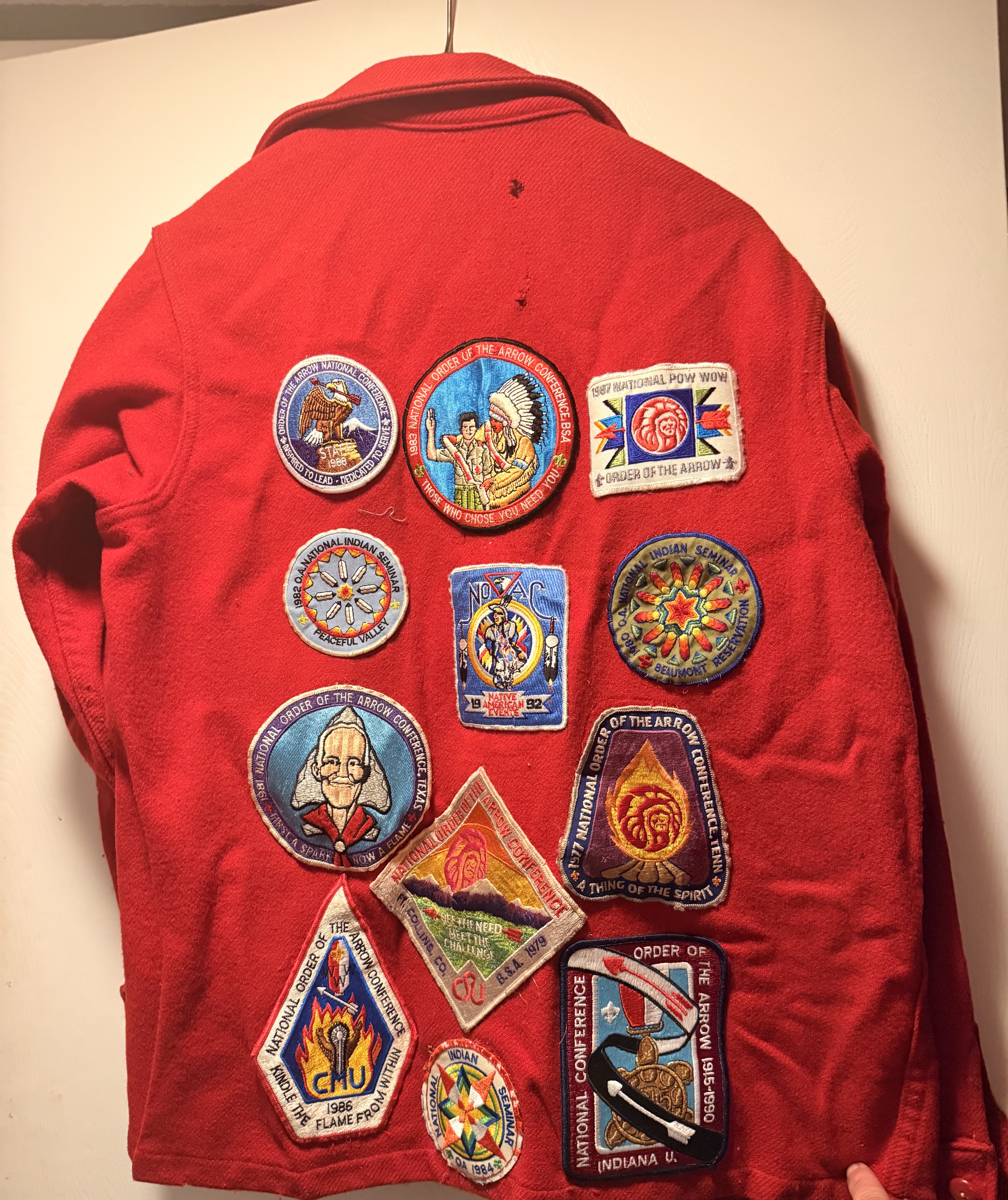
There is another red jacket in this family's story. Not a Philmont jacket — though it is the same red wool, the same BSA tradition — but one covered in the insignia of a different kind of service. It belonged to William Columbus Jennings, Jr. — Bill's father, Will's grandfather. He died in April 1994. He is missed.
The back of the jacket tells the record: National Order of the Arrow Conferences, National Indian Seminars, National Pow Wows, spanning 1977 to 1992. Fifteen years of appearing at the national level of Scouting. These were not local events. They required selection, preparation, and the willingness to come back, year after year, and give the program what it needed to run.
The Order does not give patches for showing up. These patches are for being chosen — and for coming back.
The Order of the Arrow is Scouting's honor camping society. Membership is by election from one's own troop. Service at the national level is rarer — it means the organization itself came to rely on you, that the OA's national programs were built in part on what you chose to give across a decade and a half.
The jacket accumulates that record the same way a Ranger's jacket accumulates trail miles and earned insignia. Patch by patch, year by year, event by event, until the red wool becomes a document of what a life in Scouting looked like. This one does not need a caption. Anyone who spent time at those conferences will read it at a glance.
Turn the jacket over and there is one more thing: a Philmont black felt bull on the front. He attended a Philmont Training Center class — the ranch's professional development program for Scouting leaders — and earned the right to wear it. But look closely at the tail. It falls naturally. It does not cross over the shoulder. He came to Philmont. He never stood on the Tooth of Time. That particular mark — the tail lifted, the summit claimed — belongs to the next generation.
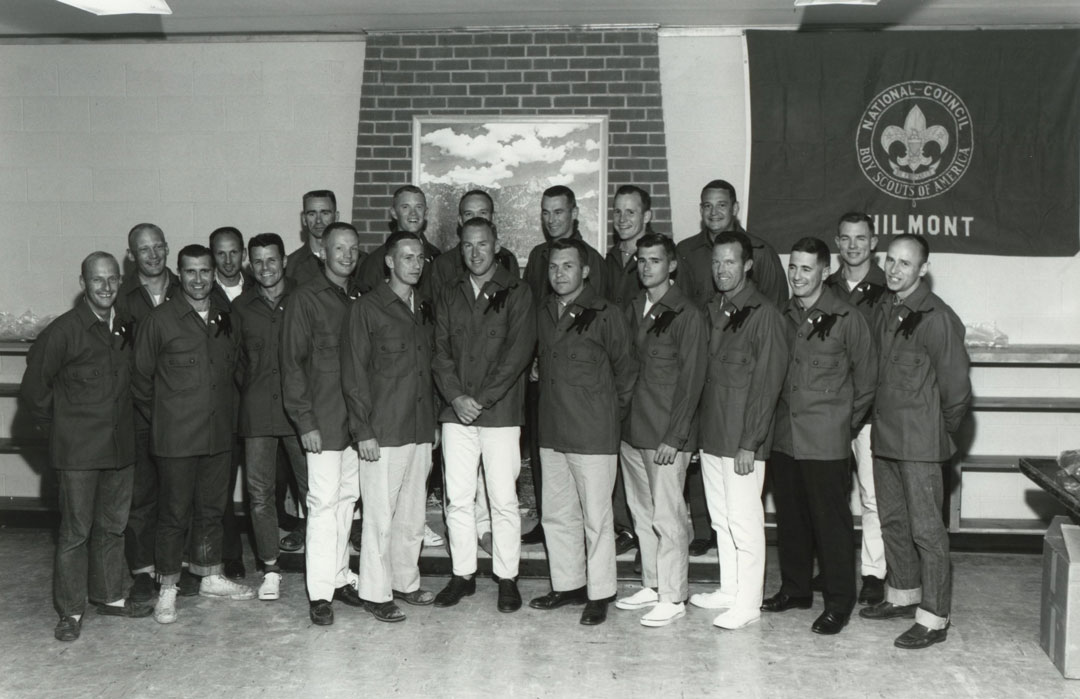
Pete Conrad · Buzz Aldrin · Dick Gordon · Ted Freeman · Charlie Bassett · Walt Cunningham · Neil Armstrong · Donn Eisele · Rusty Schweikhart · Jim Lovell · Mike Collins · Elliot See · Gene Cernan · Ed White · Roger Chaffee · Gordon Cooper · C.C. Williams · Bill Anders · Dave Scott · Al Bean
Beginning in March 1964 — five years before Apollo 11 left the launch pad — NASA sent its astronauts to Philmont Scout Ranch on geology field trips. The terrain of northern New Mexico, volcanic and ancient and rugged at altitude, was chosen to introduce them to the kinds of geologic formations they might encounter on the Moon. The land that had been shaping Scouts for years was pressed into service shaping the men who would walk on another world.
The group photograph above was taken in June 1964 in front of what is now the medical re-check building at Philmont — the same doors every backcountry participant walks through today before hitting the trail. Twenty astronauts stand together in the New Mexico sun. Among them: Neil Armstrong. Buzz Aldrin. Jim Lovell. Gene Cernan. Bill Anders. Al Bean. Mike Collins. Half of the men who would ever walk on the Moon walked through those doors.
"Half of the astronauts who walked on the moon walked through these doors. What will your legacy be?"
That line now hangs as a banner inside the building. Every crew that comes to Philmont passes beneath it on the way to the backcountry.
There is one more detail that belongs to the red jacket story. Before the astronauts departed the ranch in 1964, Philmont's warehouse manager — a young man named Stephen Keith, working the summer season — opened the trading post so they could shop. Then he packed a red Philmont jacket for each of them, writing down their names as he went. He recognized only one: Gordon Cooper. He had no way of knowing he was packing jackets for men who would stand on the Moon. The jackets were the same ones the Rangers wore. The same ones the Scouts earned. The same bull on the chest, the same deep scarlet wool. They left Philmont wearing what everyone else wore — and then they went somewhere no one else had ever been.
The Ranger Buckle · A Credential 45 Years in the Making
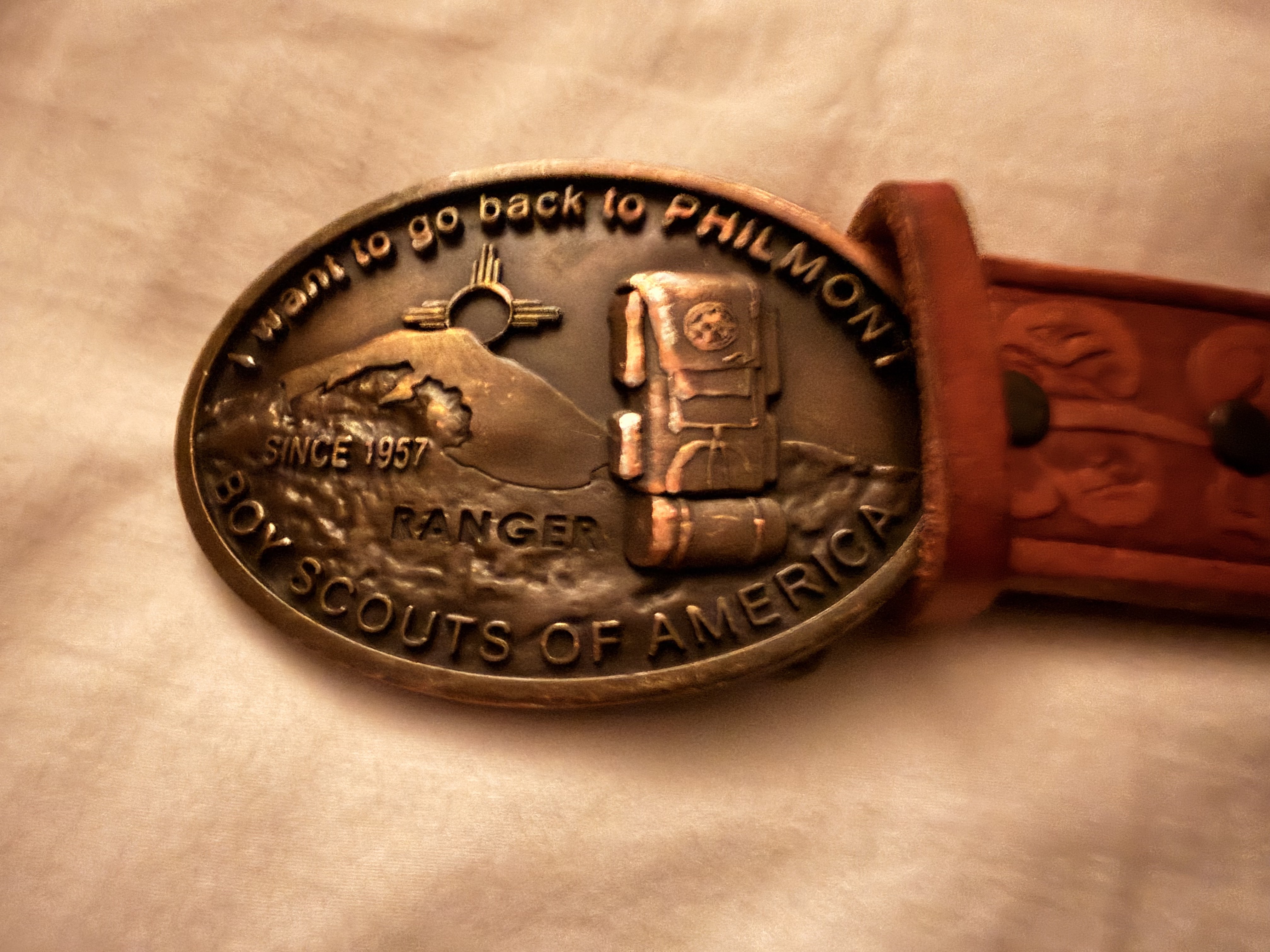
Bill earned the right to wear this buckle in 1981. The physical buckle itself — cast only in recent years — is a credential that took 45 years to hold in hand. On August 14th he wears it at the start of the day. At the branding in Scene 8, when Olivia burns the mark into the new belt, the old buckle retires. Real iron, real smoke, real permanence. The old credential yields to the new covenant.
Philmont Scout Ranch · Official Position Description
Position Description
The Ranger is responsible for cheerfully and willingly serving as a member of the Ranger Department, the objective of which is to serve the campers and advisors who come to Philmont. His/her primary duty is to educate participants in Philmont backpacking practices and outdoor ethics. The Ranger is a frontline representative of Philmont Scout Ranch and is directly responsible to his/her Ranger Trainer.
Philmont Requirements- Provide and maintain a cheerful, helpful, and efficient service to all Philmont guests. Insure that all participants have a safe and enjoyable experience. When possible, solve their needs and concerns; when not possible, direct them to someone who can.
- Carry out the prescribed policies and procedures of the Philmont Scout Ranch as outlined in the Staff Guidebook and during staff training.
- Present oneself to every participant and guest clean, sharp-appearing, and correctly uniformed as described in the Staff Guidebook.
- Become familiar with all materials supplied prior to the camping season.
- Become familiar with all pertinent Philmont policies and procedures.
- Must be 18 years of age by time of employment.
- Ability to hike up to 15 miles a day over rugged, mountainous terrain while carrying a 45-pound backpack.
- Ability to effectively communicate Philmont camping procedures to crews.
- Actively participate in all training requirements and pass the Ranger Basic Test after a five-day backcountry training trek.
- Be an advocate and expert of the Ranger Field Book and Philmont camping method.
- Submit a completed Philmont Health and Medical Form, meet the Height/Weight Requirements for backcountry participation, and be able to lift and handle 70 pounds.
- Be an enthusiastic, friendly, and effective educator of outdoor skills and wilderness ethics.
- Be a frontline representative of Philmont and give crews the information and training required to have a successful trek in the backcountry.
- Be an attentive resource for a crew during an assignment, both in Base Camp and in the backcountry, and prepare them to have a successful experience over the duration of their trek.
- Assist other departments across the Ranch to ensure its mission and the efficient operation of program is upheld.
- When assigned a crew, greet them and prepare them for their trek. Guide them through Base Camp with stops at Registration, Medical Recheck, Logistics, Outfitting Services, Dining Hall meals, chapel services, and opening campfire. Conduct a shakedown of all personal and crew equipment to ensure the crew's readiness to hit the trail.
- On the second day with a crew, depart for the backcountry and educate the crew on navigation, hiking etiquette, campsite setup, bear and wildlife procedures, first aid, cooking skills, and Philmont history.
- On the third day with a crew, observe and evaluate the group's knowledge of material instructed the previous day. Re-train the crew and go into more detail if they do not display a satisfactory understanding of Philmont's backcountry protocol.
- Throughout an assignment with a crew, develop leadership skills in all youth and adults and give guidance to the Crew Leader, Chaplain's Aide, Wilderness Pledge Guia, and Advisors in the duties of their respective roles.
- Towards the end of an assignment, pass on information about wilderness stewardship and outdoor ethics using the Philmont Wilderness Pledge as well as personal stories and insight.
- Complete required paperwork and documentation in a timely fashion.
- If called upon, serve as a replacement advisor for a crew, ranging from 1–12 days in length.
- Under direction from the Chief Ranger, an Associate Chief Ranger, or a Program Coordinator, be willing to serve as a team member on a Search and Rescue operation.