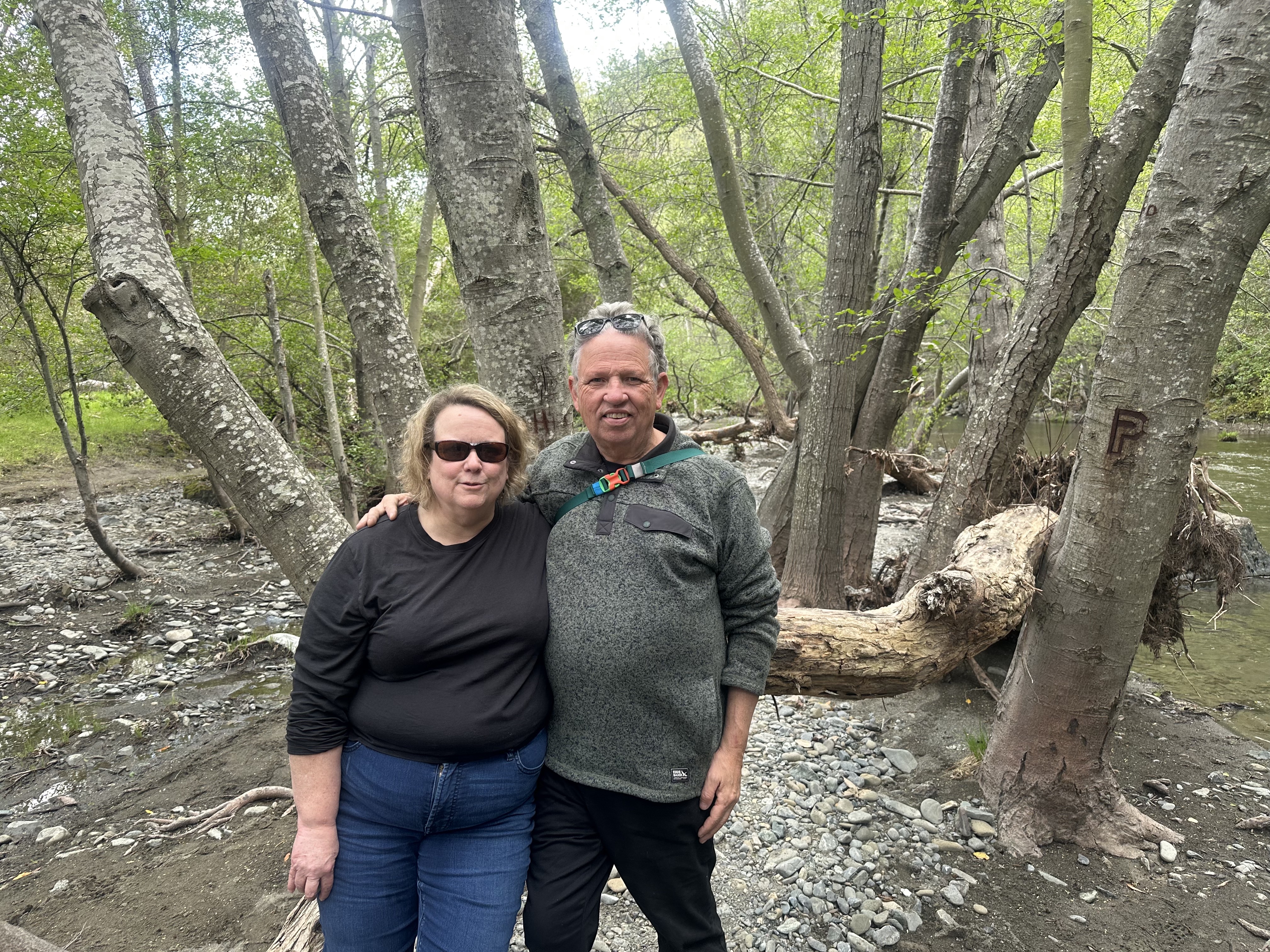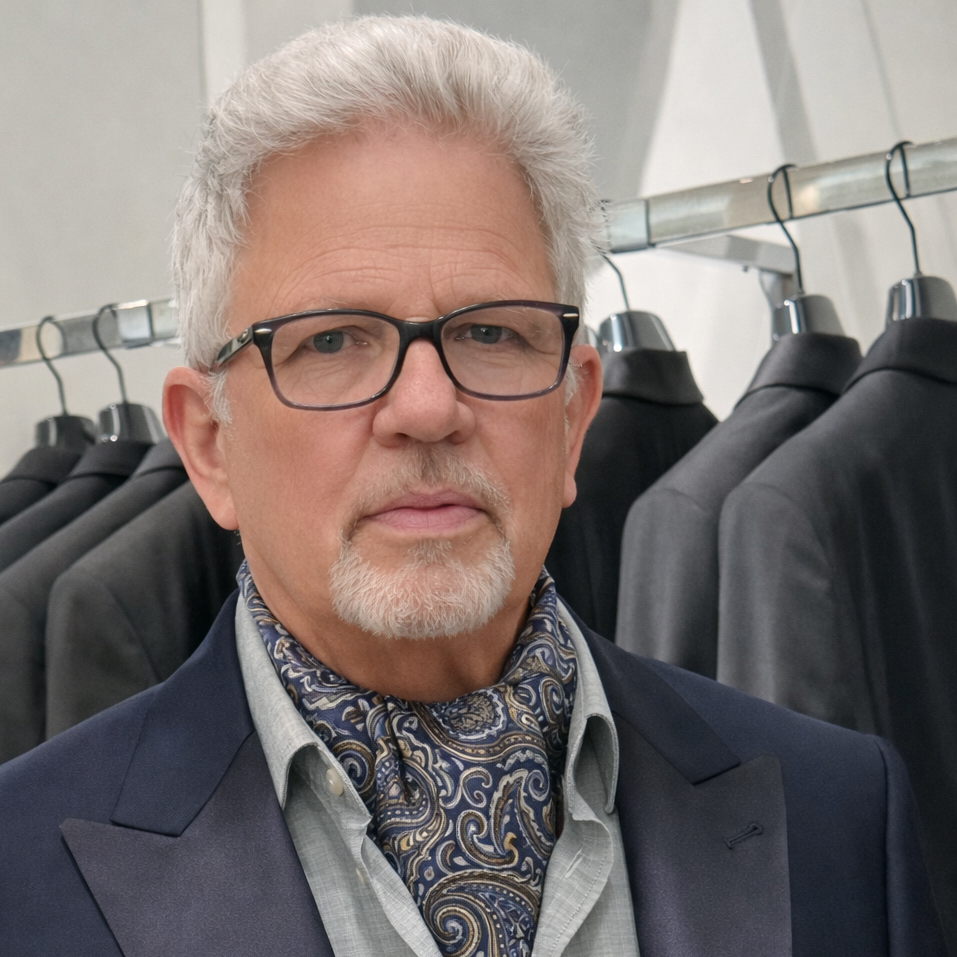
William Eugene Jennings · The Groom · August 14, 2026
Before he was two years old, he would walk up to his mother and hand her a screw and say: Bill Unscrew. She kept a mason jar for the pieces. Later that week, she would find whatever he had taken apart, go to the jar, and put it back together.
This is not a metaphor. He took apart everything he could reach. He once removed a pot handle with his bare hands while she was cooking, and the handle fell off. The curiosity was not a phase. It was the whole shape of the man.
He grew up in Memphis, the son of William Columbus Jennings, Jr. — an insurance executive whose name in the Commercial Appeal ran under the headline Jennings Heads Firm — and Ann Dewitt Prather, a craftsperson of startling range. His mother was a Scoutmaster's wife, a needlepoint artist, a porcupine quill embroiderer who debunked anthropological orthodoxy about how that craft actually worked. She entered twelve pieces into the Mid-South Fair one year — one allowed per category — and won the blue ribbon in all twelve. After that they asked her to judge, to give others a chance.
His uncle Bob — Robert James Prather, Jr. — graduated second in his class in engineering from the Naval Academy in the 1950s and died in a Cold War car accident while serving as Chief Engineer for the Poseidon C3 and Trident C4 nuclear missiles. When Bill was ten, they spent an entire day together at the Smithsonian's Air and Space Museum, Uncle Bob explaining everything. That afternoon made him an engineer.
He was going to be a chemical engineer. He was good at it — top ten in Tennessee in state chemistry competitions as a sophomore, state Science Bowl with a team that placed well. Senior year, Advanced Placement Chemistry under Dr. Marking, perfect scores on every exam and lab.
Then three of them were in the lab during lunch, distilling denatured alcohol, and a classmate named Ken Witt picked up a gallon metal container and poured it over an open flame. Brice, the third student, threw the can behind the lab benches. It exploded less than two inches from the top of the bench, five feet from where Bill stood. It peeled paint along forty feet of wall and drove metal fragments into the ceiling. The fire extinguisher wasn't charged. The fire alarm brought the faculty out slowly, because the principal had announced a drill that morning.
Nobody was called to the office. The teacher never mentioned it. His parents knew, and said nothing. Years later, he asked his mother why. She said: Son, I had trouble punishing you for this — you see, I blew up my chemistry lab as a senior in High School.
He changed his major to electronics. He attended Georgia Tech on National Merit and Navy ROTC scholarships, pledged Kappa Alpha Order, and graduated cum laude with a full Bachelor of Electrical Engineering — completing two and a half years of coursework in four calendar years by working between terms, taking over twenty hours a semester to graduate early. He dropped the ROTC scholarship and paid his own way, including a co-op at IBM and full-time work as a computer technician in San Angelo, Texas.
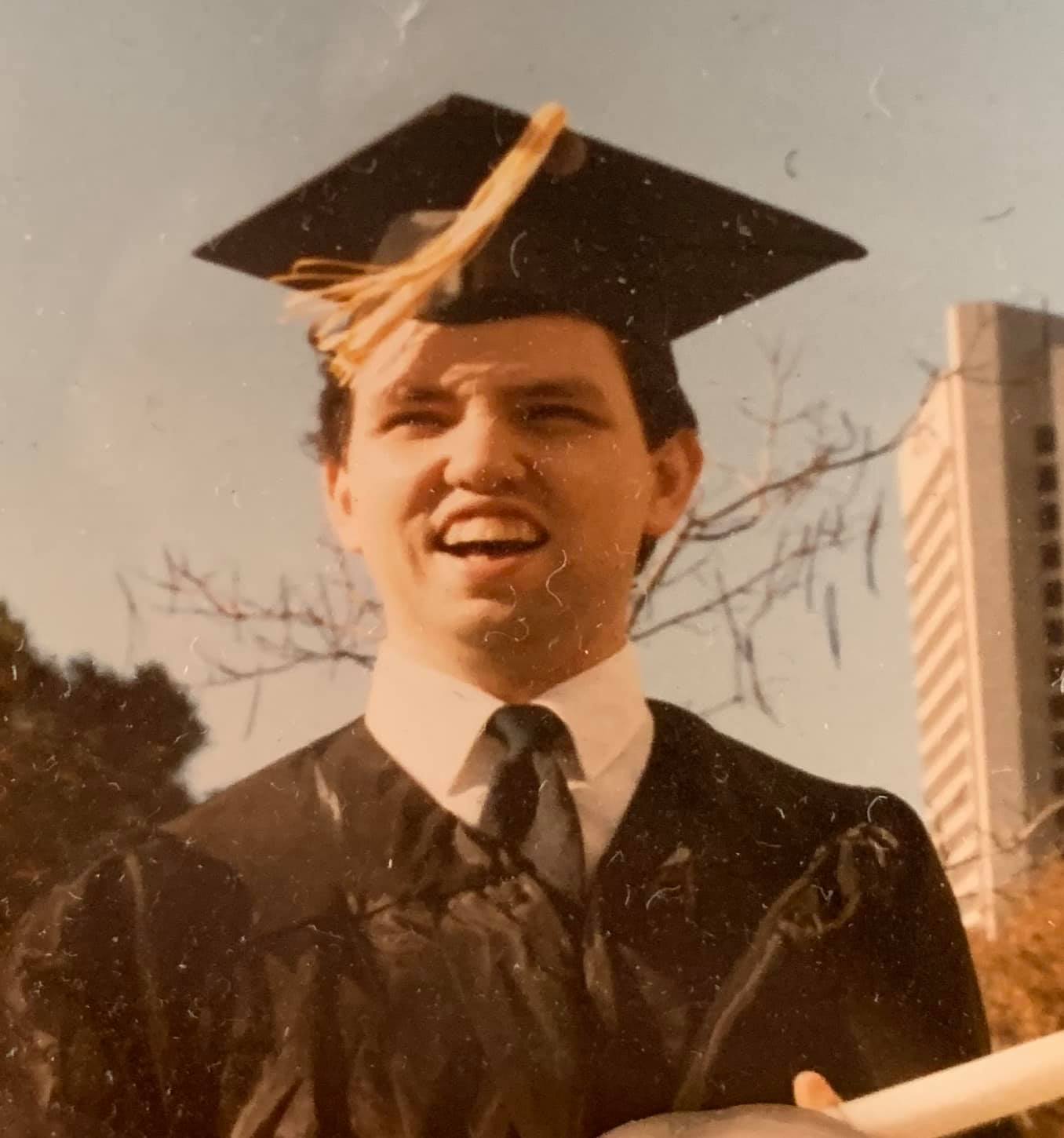
He started at Intelligent Systems in Atlanta, where he developed the industry's first Intel 80386 CPU accelerator and conceived "Quadram Inside" — the tagline that became, in a competitor's hands, Intel Inside. He moved to Edsun Labs in Waltham to help bring Continuous Edge Graphics from broadcast television into personal computers. Edsun was acquired by Analog Devices in 1991.
At Coral Networks in Westborough — where he was the first engineer hired — he led development of the world's first hardware-based multi-protocol packet switch, handling FDDI, Ethernet, Token-Ring, T1, and T3 traffic simultaneously. Coral was acquired by Synoptics in 1993. Cisco came calling the following year.
At Cisco he stayed for fifteen years, through the period of hyper growth when the company doubled in revenue for seven consecutive years. He built the world's first monolithic optical-speed network processor — internally called "Toaster" — from a sixteen-CPU-on-a-die demonstration in 1997 into a product line that generated over ten billion dollars in revenue. He led development of the Quantum Flow Processor, which powers the ASR router series today, generating over twenty billion dollars since launch. He introduced the world's first Ten Gigabit Ethernet switch port. He managed the enterprise switching platform that generated four billion dollars annually. By the end of his tenure, 80 percent of global internet traffic traveled over infrastructure he had conceived and built.
At FarmX, he directed a sensor network for commercial farms throughout California, measuring soil and plant conditions at densities that have never existed before. He left in 2024 — the company was struggling financially, and family needed him present in a way that the job could not accommodate. In June 2025 he joined Knightscope as Chief Program Engineer for the K7 Autonomous Security Robot. The arc from network processors to atomic clocks to agricultural sensors to an autonomous robot that patrols a parking structure is, on reflection, entirely consistent.
He holds twenty-five US patents. His earliest, US 5,490,252, filed at Coral in 1996, has been referenced by 453 subsequent patents. His most-cited Cisco patent — US 6,101,599 — has been referenced 93 times. The work compounds.
He named each of them deliberately. Olivia Nicole, for her mother's favorite aunt — Tia Coca, whose real name was Olga, Russian for Olivia. Will — William Charles — for his two grandfathers, Charles Bock and William Jennings, keeping his father's initials WCJ. Henry Prather, for his maternal grandmother's maiden name: Henry Prather was a lieutenant who served with George Washington in the French and Indian War. Mark Daniel, for the second great-grandfather Daniel Jennings — initials MD, and Bill suspects a future doctor. Elizabeth Ann, for Tricia's confirmation name and for his mother's first name, Ann.
He has raised them alone since September 2014, with help from a network of friends, neighbors, homeschool families, the Catholic community at Our Lady of Peace, the Hoffmann family, the Snodgrass family, Coach Larry Williams, Damon Rich, Maureen Kilkeary, and Claudia Vanesa Echeveste, who quit her job in Chile to come stay with the family after Tricia died. He is grateful for all of them. He has said so, by name, on paper.
Flora moved into the house during COVID, after a few years of dating. The children were homeschooled before she arrived. They are not anymore. They have clean rooms. They are in drama and sports and robotics and choir. She did not come into the house as a guest — she came in as someone who saw what needed doing and did it. Her influence on all of them, Bill included, is not subtle. It is measurable.
Olivia is the eldest — petite, feisty, verbally gifted in the way her mother was. She earned her Eagle Scout in 2021, grew Troop 582 to sixty scouts during a pandemic, and is now at Gonzaga on a near-full scholarship. Will has the same social comedic timing as his grandfather, and his own Eagle Scout. Henry earned his Eagle too — Grand Slam of all four BSA high adventure bases, World Jamboree, a natural outdoorsman. Mark earned Eagle at twelve, with eight Palms and seventy-nine merit badges; the initials MD may yet come true, but he has not waited on them. Elizabeth — Ellie — was four months old when her mother died. She is named for a Revolutionary patriot who shares her name. She earns her Eagle Scout in 2026 — two hundred and fifty years after the birth of the country her ancestor helped found.
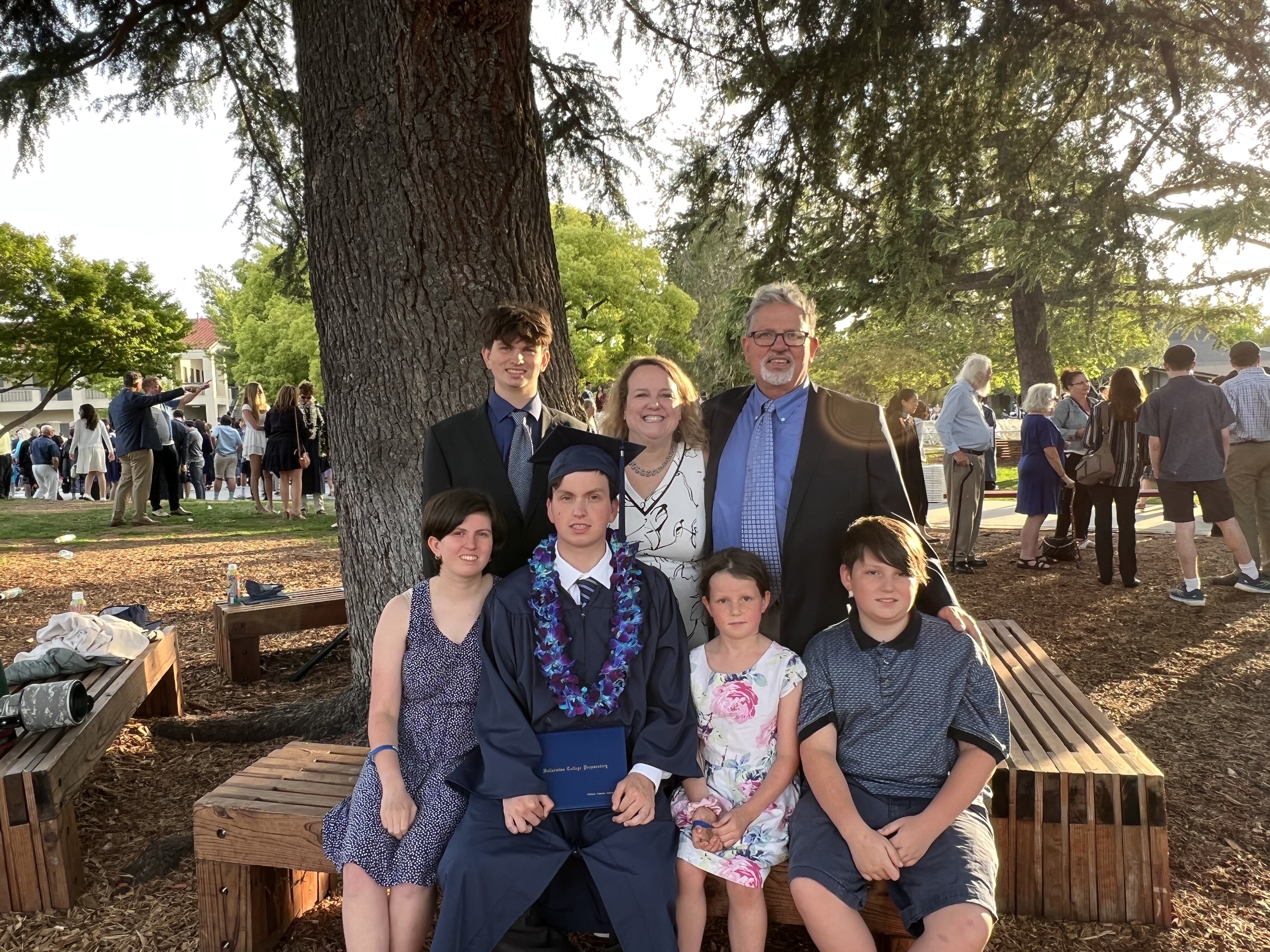
The children were also members of the Children of the American Revolution. One afternoon while Bill was visiting his mother in skilled nursing in Cupertino with her sister, his aunt Cookie, Tricia texted him: Will had nominated him to be Senior President of the San Jose CAR chapter — and everyone had elected him, in his absence, while he sat in a care facility across town. Membership in the SAR was required to serve. He joined under the Cullen Conerly application, through the Prather line; Olivia, Will, and Henry joined under the same. The SAR's genealogists subsequently verified thirty-five patriot ancestors — including Elizabeth Hicks Prather, the first female patriot verified; Jack Beckham, a spy; and Elles Palmer, who served at Valley Forge. Mark joined the CAR through Jack Beckham. Ellie joined through Elizabeth Prather — the family's female patriot, claimed by the youngest daughter, who shares her name. He was later awarded the Robert E. Burt Boy Scout Volunteer Award. It is worth noting that Flora is eligible for the DAR through four direct lines. Between the two of them, the Revolution is well represented at this wedding.
His father was a Scoutmaster for Troop 34 in Memphis — but kept Bill in a different troop, so he would not be "the Scoutmaster's son." His mother received the Red Arrow Award, one of fifty-two ever given in the history of the Boy Scouts. His father was selected for the Distinguished Service Award from the Order of the Arrow in 1994, one of twenty-five in the country that year — and died before it could be presented. They do not give the award posthumously.
Bill is an Eagle Scout with four Palms. He served as a Philmont Ranger — one of the most demanding volunteer roles in Scouting, requiring the ability to hike fifteen miles a day over mountainous terrain with a forty-five-pound pack, available to only the best Eagle Scouts. He was elected Section Chief of the Order of the Arrow for Section Southeast Region II, covering Tennessee and Kentucky. He coordinated National Leadership Training Seminars. He taught at National Order of the Arrow Conferences and National Indian Seminars. He was invited to teach conservation practices at the National Jamboree. He holds the E. Urner Goodman Founder's Award — given to those who personify the spirit of selfless service — and the Vigil Honor.
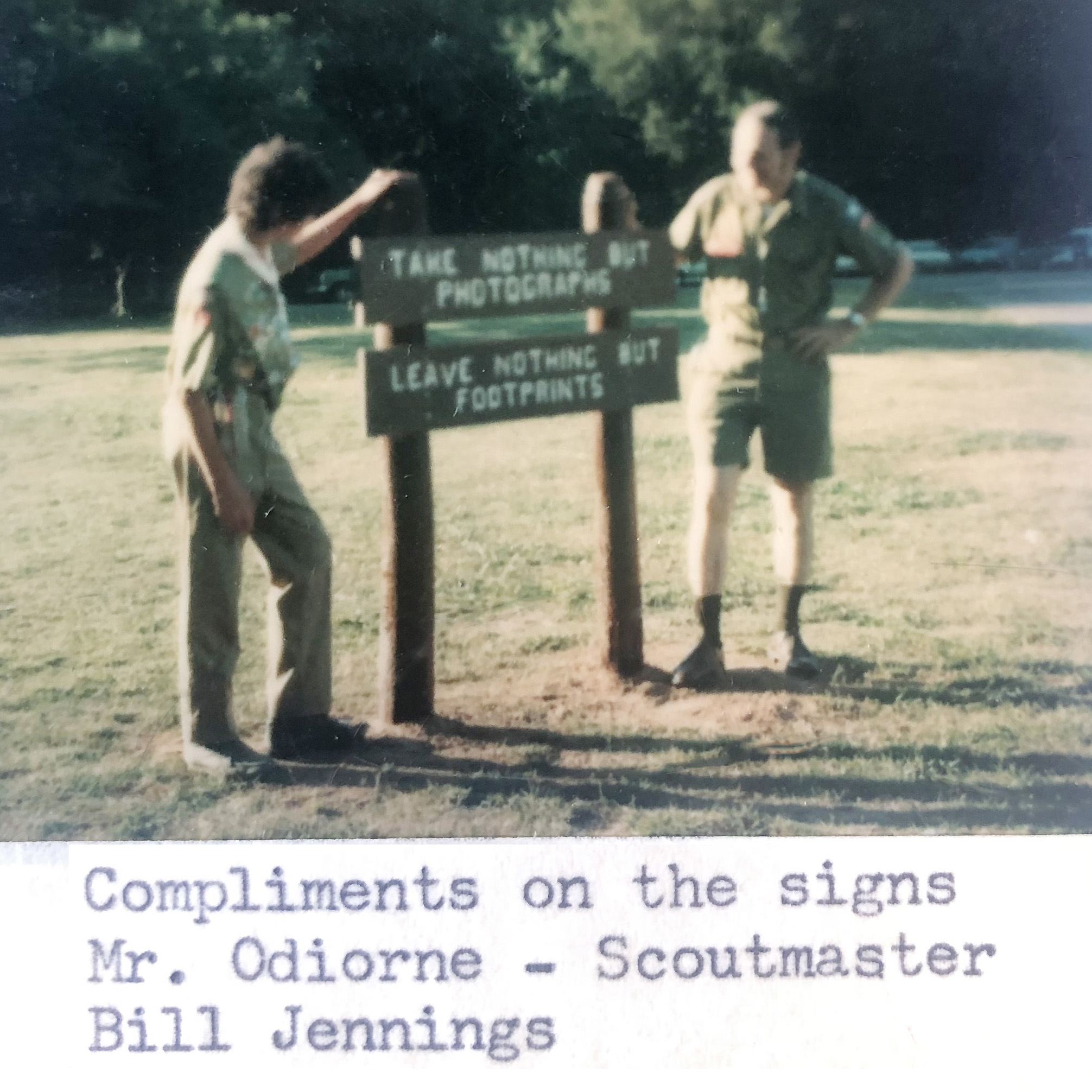
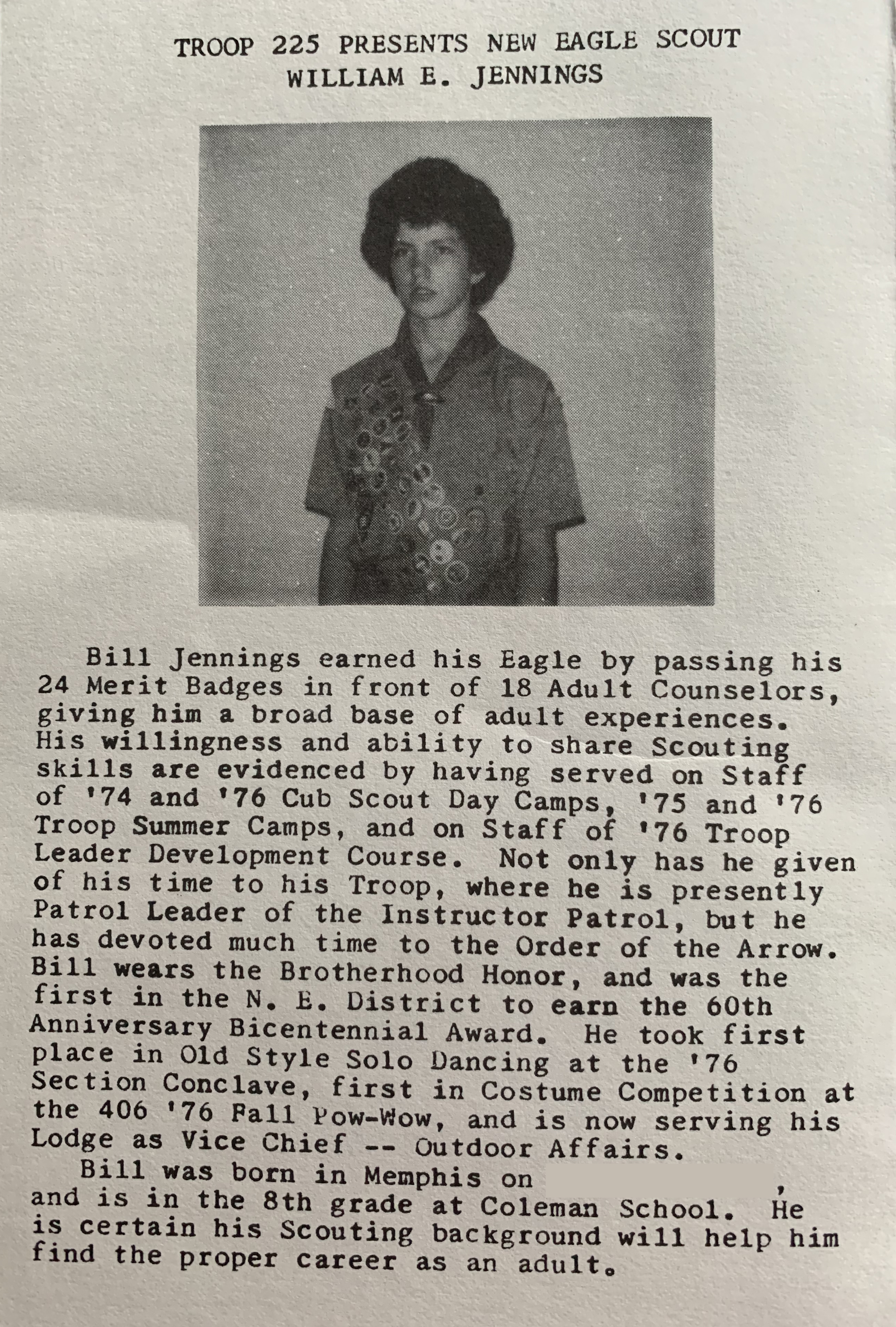
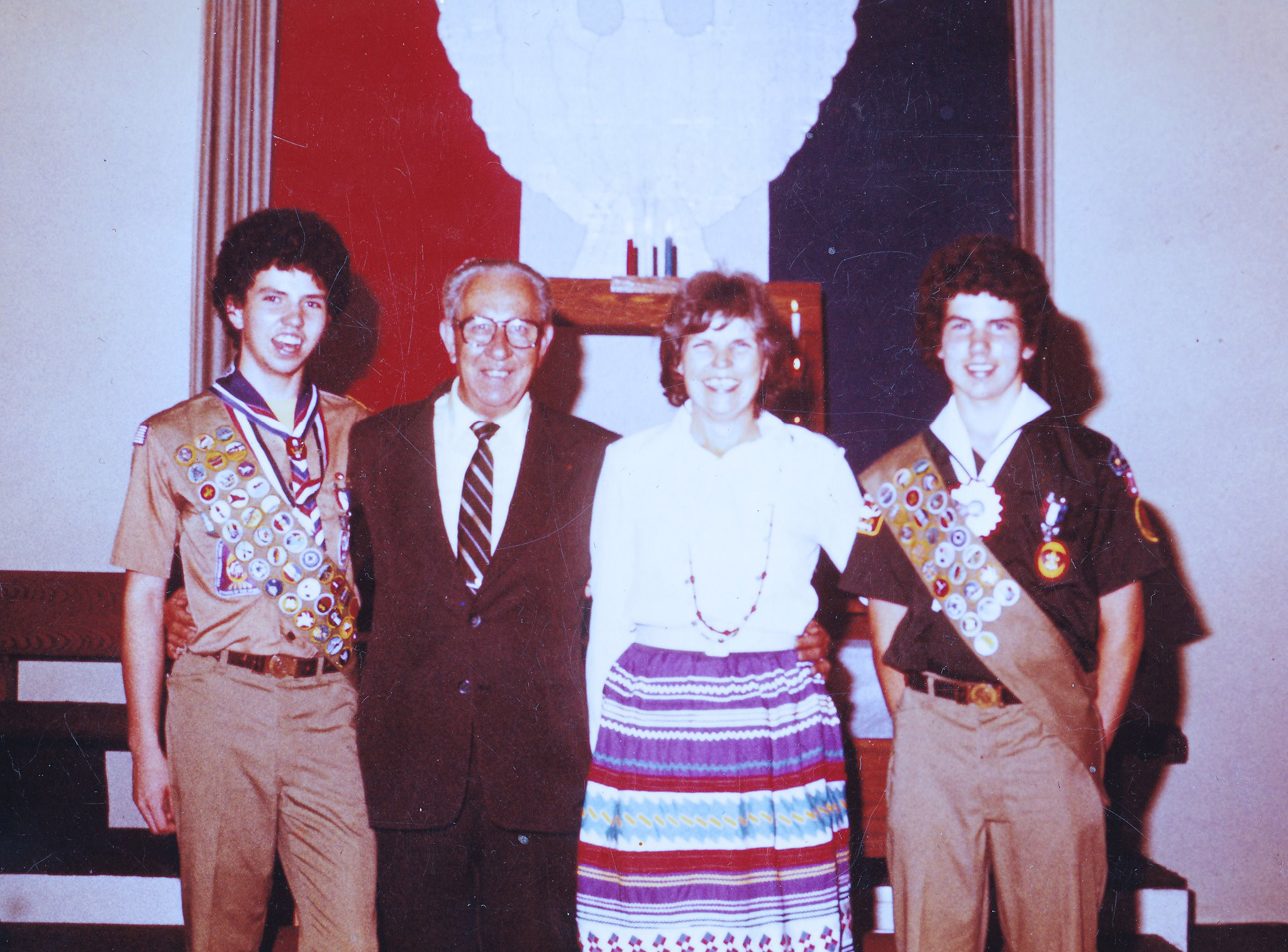
When Bill earned the Star rank, his father gave him his own Star pin — the one he had earned in the thirties. Later, when his father was inducted into the Vigil Honor, Bill draped his OA sash from his own shoulder to his father's, as Chief of the Fire, on a cold February morning.
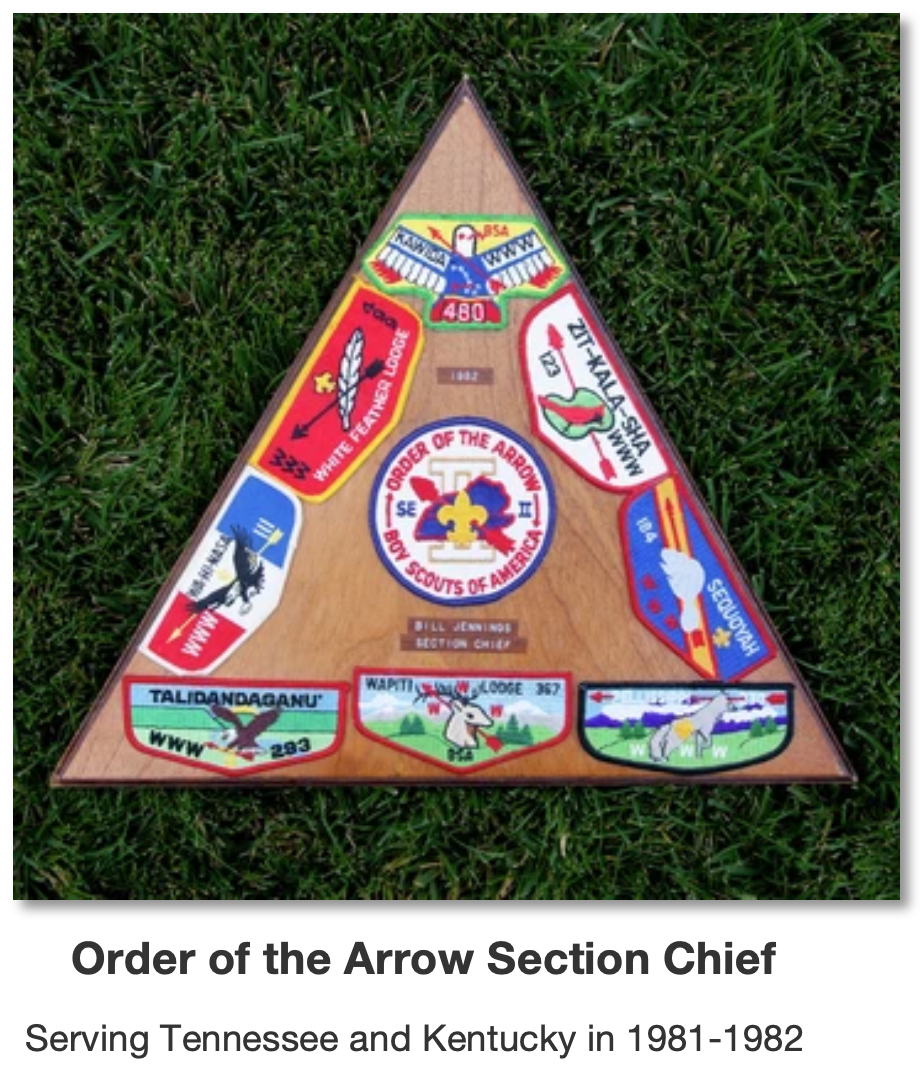
As Section Chief, Bill ran the business of the section and hosted the annual conclave for all eight lodges across Tennessee and Kentucky. The 1981 conclave was held at Camp Pellisippi in the Great Smoky Mountains — the one he had spent a long day running. One still afternoon after the work was done, his father sat with him on the steps of the dining hall stage and said, quietly: well-done, son. He didn't mean the efficiently run Conclave. He meant something larger. Bill understood. At that same conclave, his Section Advisor Bill Ketron presented him with a handmade triangular plaque — the SE II area patch at center, surrounded by the patches of all eight lodges he had served.
His Order of the Arrow Vigil name, chosen by others in the Lenni Lenape tradition, is Wunita. It means: He who is able.
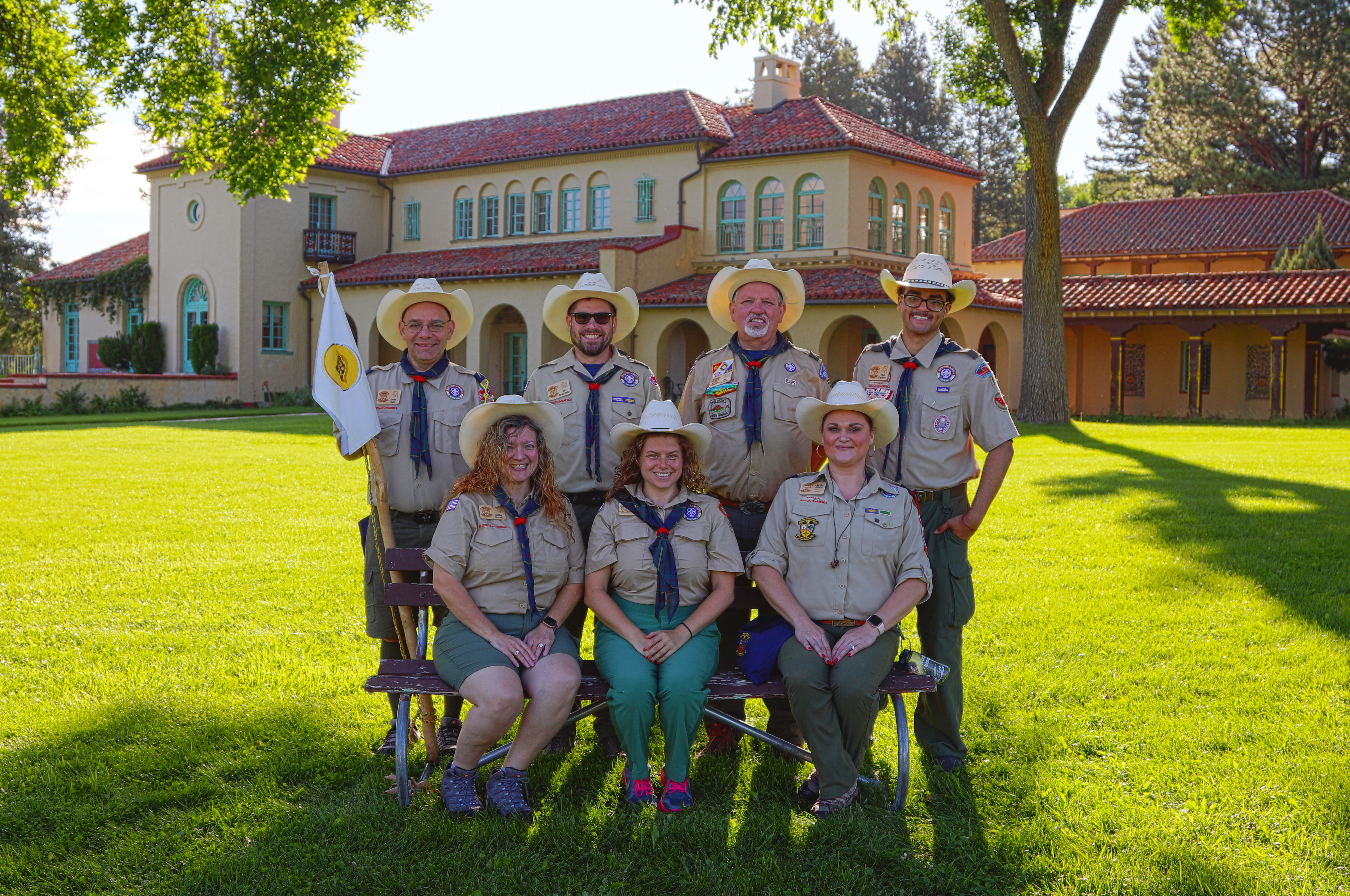
He is currently Assistant Scoutmaster of Troop 2457 — Ellie's troop — and founded Troop 582, the female troop, in 2019, which Olivia led to sixty scouts during the pandemic before he stepped back in 2023. The scouts call him Mr. Bill. He finds this quietly funny: Mr. Bill was a clay figure on Saturday Night Live in the late 1970s, perpetually cheerful, perpetually meeting disaster. The scouts have no idea. He has not told them.
He has won jam-making contests. His Strawberry–Black Pepper–Balsamic jam is a signature. His Meyer Lemon and Blood Orange marmalade took first place at the Annual Los Altos Jam Making Contest at the Los Altos History Museum. He makes mushroom risotto and cheese soufflé and French onion soup with the same seriousness he brings to processor architecture. His wood-burning outdoor pizza oven reached 800 degrees Fahrenheit. He could cook a pizza in two minutes. He cooked a sixty-three-pound pig in his yard with his father-in-law Charles Bock, using indirect heat, coals in the corners, for a luau of 120 people as a fundraiser for the Los Altos History Museum. When the pig was done, they wrapped it in foil on a sheet of cut plywood and wheeled it six houses down to the party on a wagon.
In what he describes as a few moments of insanity, he once bought and operated a barbecue restaurant in North Carolina called Carolina Joes. The T-shirt read: Stop Starin' at My Buns. He sold the restaurant, later, with Tricia's help — she handled the negotiations from Sacramento while working as his personal assistant, and the attorney on the other side eventually asked her: You're not just a personal assistant, are you?
He took a baking class at Sur La Table in San Francisco in June 2016. He made macarons. They were, as documented, his birthday cake macarons.
Now he cooks with Flora, which is its own different thing entirely. Not the logistics of feeding a household — the other kind. The kind where you go to H-Mart and find something neither of you has made before. He is her faithful sous chef and has been reliably informed that he dices an onion better than anyone else in the family. He has accepted this role with appropriate dignity. He is also, quietly, very proud of his chicken stock — made from leftover vegetable scraps and carcasses, the kind of thing that takes patience and a refusal to waste anything. Flora bakes. He stocks. It works.
He walked into Chef Chu's in Los Altos. She was sitting alone. That was luck — the improbable, unearned kind.
What she found was a man who had been building things his entire life: routers and switches, atomic clocks, video walls, sensor networks, historic houses, merit badges, jamming sessions in the kitchen late at night, five children he was raising by himself. He carries the losses quietly. He writes letters to his children in the middle of the night. He keeps mason jars. He takes apart things that don't work and figures out how to make them work.
He is also, as one former DARPA colleague wrote of him, a powerful strategic thinker whose goofy good looks and casual disposition should not fool anyone. Another colleague, a Technical Lead at Cisco, wrote that working for Bill was one of the best growth opportunities of my career — and that Bill's integrity and attention to detail still serve as examples of the engineer I strive to be.
Flora walked into a life that already had its own gravity, its own language, its own geography — Philmont, the Order of the Arrow, five kids with a shared history she had no part in creating. She made it home. He noticed.